AI Build
Inside Verathis
How Verathis runs end to end, from the client’s invitation to a finished report and slide deck — with me in the loop at every point the client sees.
Built from
100+ digital maturity assessments in Singapore and Saudi Arabia
Framework defined
Early 2025 at Advico, before AI agents, not yet named
First version
Google Forms and Jotform, with automated scoring and reports, in client use by late 2025
Own platform
May 2026
Rebuilt
June 2026, fully automated end to end
Launched
1 July 2026
Scoring
Fixed formulas, no AI
Writing
Five focused Claude calls, run in parallel, written to my voice guide
Review
An AI reviewer checks every section, then I do
Output
Word report and PowerPoint deck
Human in the loop
I review every email before it reaches the client
What it is
Verathis is my digital maturity assessment, built from more than 100 assessments I have carried out in Singapore and Saudi Arabia. Since it launched on 1 July 2026, it runs end to end on its own: from the client’s invitation, through their self-assessment, to a finished report and slide deck.
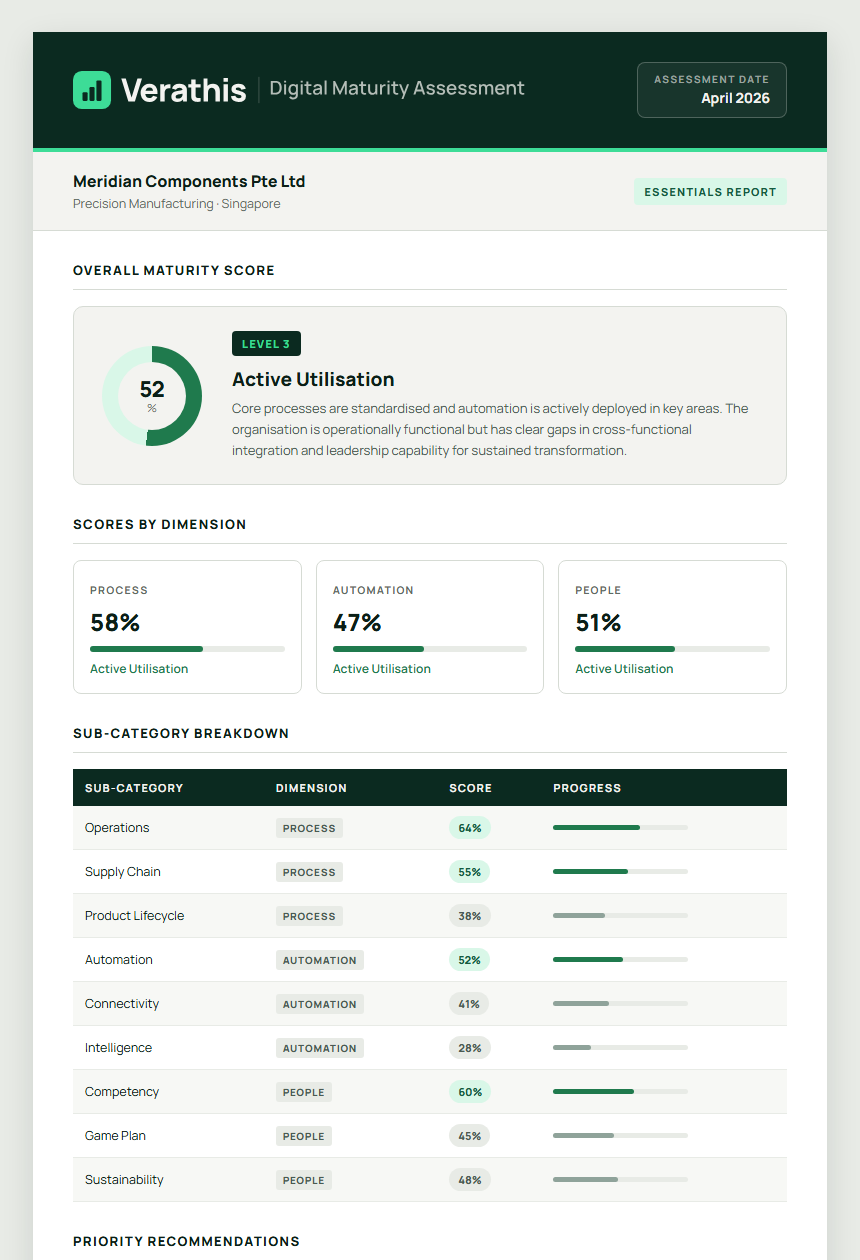
When a client finishes the 47 questions, the scoring happens straight away with fixed formulas. Nine sub-category scores, three dimension scores, one maturity level. No AI is involved in that step, because a score has to come out the same way every time.
The scores then go into a report pipeline. It writes the narrative the way I would write it as a digital transformation consultant, draws the charts, and builds the Word report and the PowerPoint deck, ready for me in my admin page.
How a client moves through it
Me
Access code and PIN
I generate the client’s access code and PIN. The invitation email is drafted automatically, and I review it before I send it.
Client
Self-assessment
The client follows the link to Verathis, logs in, and works through the 47 questions at their own pace.
System
Scored and alerted
On completion, the scores are calculated and I get an email letting me know the assessment is done.
System
Report and deck
The report and slide deck are written in my voice from the client’s own scores and answers, checked by a reviewer, and waiting in my admin page with a one-page brief for me.
Me
Results email
The email back to the client is drafted for me. I fill in the final details and send it myself.
Why the writing is split five ways
Each writing step sees only what it needs. The executive summary gets the overall score and the strongest and weakest areas. Each dimension writer gets its own scores, a short description of what that level usually looks like on a factory floor, and the client’s answers for its own sub-categories, nothing else. The roadmap gets all nine scores, lowest first, and the client’s sector.
It is the same lesson as JobPilot: a smaller, focused input gives more specific writing, and when one step goes wrong, the problem stays in that step instead of spreading through the whole report.
The rebuild
The assessment itself came first, at Advico, my consultancy. In early 2025, before it had a name and before AI agents were something I could build with, I turned what I had learned across more than 100 assessments into a framework: three dimensions, Process, Automation and People, with a scoring matrix and defined maturity levels. By mid 2025 it ran as a self-assessment on Google Forms and Jotform, with conditional routing and the scoring calculated automatically. By late 2025 it turned those scores into a visual maturity summary and a diagnostic report, and I was using it in client discovery and roadmap work.
In May 2026 I built it into its own digital tool. In June I rebuilt it as a fully automated system, so that everything between sending the invitation and reviewing the report runs without me: client logins, the self-assessment, scoring, alerts, and the writing of the report and deck. It launched on 1 July 2026.
Running it on real reports since then has shown two weak points, and I fixed both in August.
First, each dimension writer had to hand back its text in a strict data format. Long, natural prose breaks strict formats easily, and when it did, the whole dimension fell back to generic text. Now each section is clearly marked and read on its own, so if one sub-category comes back wrong, only that piece falls back and the rest of the dimension keeps its tailored writing.
Second, the roadmap slide in the deck was pulling its actions from a standard table, so every client at the same level saw the same three actions. The roadmap writer now also returns one specific action per phase, written to stand on its own as a slide bullet, so the deck says the same tailored thing as the report.
In October I added a reviewer. Before the files are built, it reads every section against my voice guide and the client’s own answers, rewrites anything generic or unsupported, and runs plain checks that no AI can talk its way past, such as every percentage in the text being one of the client’s real scores. It then sends me a one-page brief: what it changed and why, anything that failed a check, and prep for the debrief.
The first test showed the reviewer rewriting every section, because the writers had never seen the guide it checks against. Now they work from the same guide, and each dimension writer also sees the client’s answers, so the reviewer is a check rather than a second writer. The five writers also run at the same time now, instead of one after another.
When I want a section changed, I ask a Claude Code sub-agent. It drafts the new text, shows it to me next to the old, and only after I say yes does it rebuild the report and deck and replace the email draft. It never sends anything to a client.
Why I stay in the loop
Everything in the middle is automated, including the first review. Everything that reaches the client goes through me. The invitation and the results email are both drafted for me to review and send, and I check the report and deck before the client sees them. The writing is good, but it is written from scores, and scores cannot tell me what came up in conversation, which gap the team already knows about, or what will be hard to change inside that organisation. That is what the debrief is for.
What it demonstrates
Field experience from 100+ assessments turned into a product that runs end to end
Fixed formulas where the answer must be repeatable, AI only where writing helps
Five focused writing steps, each given only the slice of data it needs, written in my voice
An AI reviewer and plain data checks before anything reaches me, and a sub-agent that only changes text I approve
A person in the loop at every point the client sees, by design rather than as an afterthought
Rebuilt from real use, not left alone once it worked
Inside the pipeline
Scores in. Five focused writers. A reviewer. One sign-off.
Follow one finished assessment through the pipeline. The scores are calculated first, each writing step picks up only its own slice, a reviewer checks the lot, and nothing goes to the client until I have reviewed it.
Writing the same report every week?
Inspection summaries, customer quotes, monthly performance packs — if your team keeps writing the same kind of report, the structure is usually already in someone’s head. I help businesses map that structure and build a pipeline around it, with a person still signing off at the end.