Building AI Agents Without Code
The AI tool was unfamiliar. The work was not.
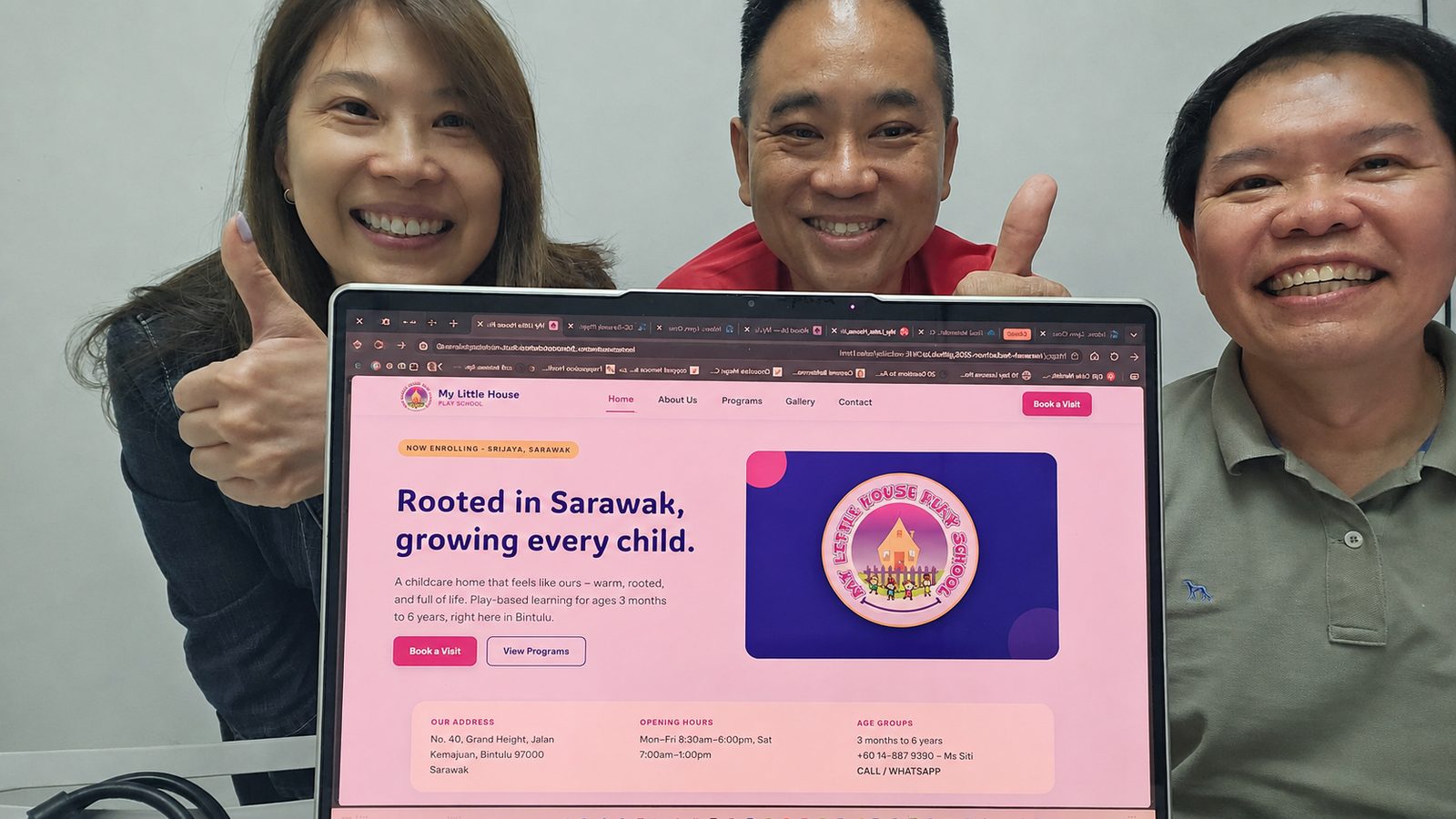
Two days before the hackathon, I had never opened Kimi AI. By the end of the second day, my team had used it to build and ship a live five page website for a childcare centre in Bintulu, Sarawak. We placed second runner up out of eleven teams. The result was good. The part I keep coming back to is smaller than that.
I joined the Singapore–Sarawak Friendship AI Business Design Hackathon virtually from Singapore, with two teammates, Francis Lee and Lynn Choa. The full account of what we built, and who we built it for, is on the project page. This is the reflection that did not fit there.
The team came out of the same community
Francis and Lynn did not come out of nowhere. Both of them went through the same one day AI Native Circle bootcamp under Wan Wei Soh that I did, just not at the same time. Lynn was in my cohort. Francis was in a later one, the cohort where I had come back to volunteer as a facilitator. Same community, different rooms.
So when Francis pulled me into the hackathon and I brought in Lynn, we were not three strangers assigned to a team. We had each learned to build our first AI agent through the same programme, and we had watched each other do it. That shared starting point mattered more than any single skill on day one. We trusted that everyone would work their part out, because we had all done exactly that before.
The network you build while you are learning is not a side benefit. It becomes the people you build with later.
What surprised me was how much the tool could hold
I went in expecting the constraint to be speed. It was not. What stood out was how much context Kimi AI could carry without losing the thread.
We fed it the full brief from the business owner. The real programme details. The warm, parent facing tone she asked for. Then we kept building on top of all of that, page after page, and it held. We never hit the point where the tool forgets what you told it an hour ago and you have to start explaining yourself again from the beginning. For a two day sprint with no time to redo work, that was the difference.
The skills were never tied to the tool
This is the part that made the whole thing click for me.
I did not learn to build websites on Kimi AI. I learned the fundamentals at Boon Kgim’s Claude Code Foundation Workshop, on a completely different tool. How to describe a business clearly. How to structure a site. How to give an AI the right information in the right order so it produces something usable rather than something generic.
At the hackathon, none of that had to be relearned. The tool was new. The work was the same shape. We pointed the same approach at Kimi AI and it worked.
If you are learning to build with AI right now, that is the thing worth protecting. Do not attach yourself to one tool. Learn the shape of the work, because the tools will keep changing and the fundamentals will not.
The result that actually matters
We placed, and that is on the certificate. The outcome I think about more is that a childcare centre in Bintulu now has a real website, one that parents can use to find it, because a group of people showed up for two days and built it at no cost.
That is what this kind of AI work can do for a small business. Not a demo that impresses a room. A real presence in a place where the business had none before.
If you run a small business and you have been waiting for the right moment to get online properly, the tools are now good enough that the moment has arrived. The full story of the build is here. If you want to talk about doing something similar for your business, get in touch.

Written by Damien Goh
I help manufacturers and F&B businesses turn their operational knowledge into practical AI agents and clearer digital transformation decisions. Based in Singapore.
Related reading
Want to talk about this?
Whether it sparked a question or you want to explore how it applies to your work, I am happy to chat.
Get in touch