Building AI Agents Without Code
Inside JobPilot: how one AI agent became five
In March 2026 I was job searching, and I was doing what most people do. Tailoring a resume for each role, keeping a spreadsheet of applications, chasing follow-ups I had promised myself I would send and then forgot about by Thursday. It was tedious in a very specific way. Not hard. Just repetitive enough that my attention kept sliding off it.
That same week I signed up for the ANCHR AI Native Bootcamp, a one-day session run by Wan Wei Soh where a room of non-technical professionals learns Claude Cowork and ships real AI agents before the day is out. I went in with no plan to build anything related to my job search. I left having built JobPilot, an agent that handles the parts of that process I was quietly dreading.
What I actually built
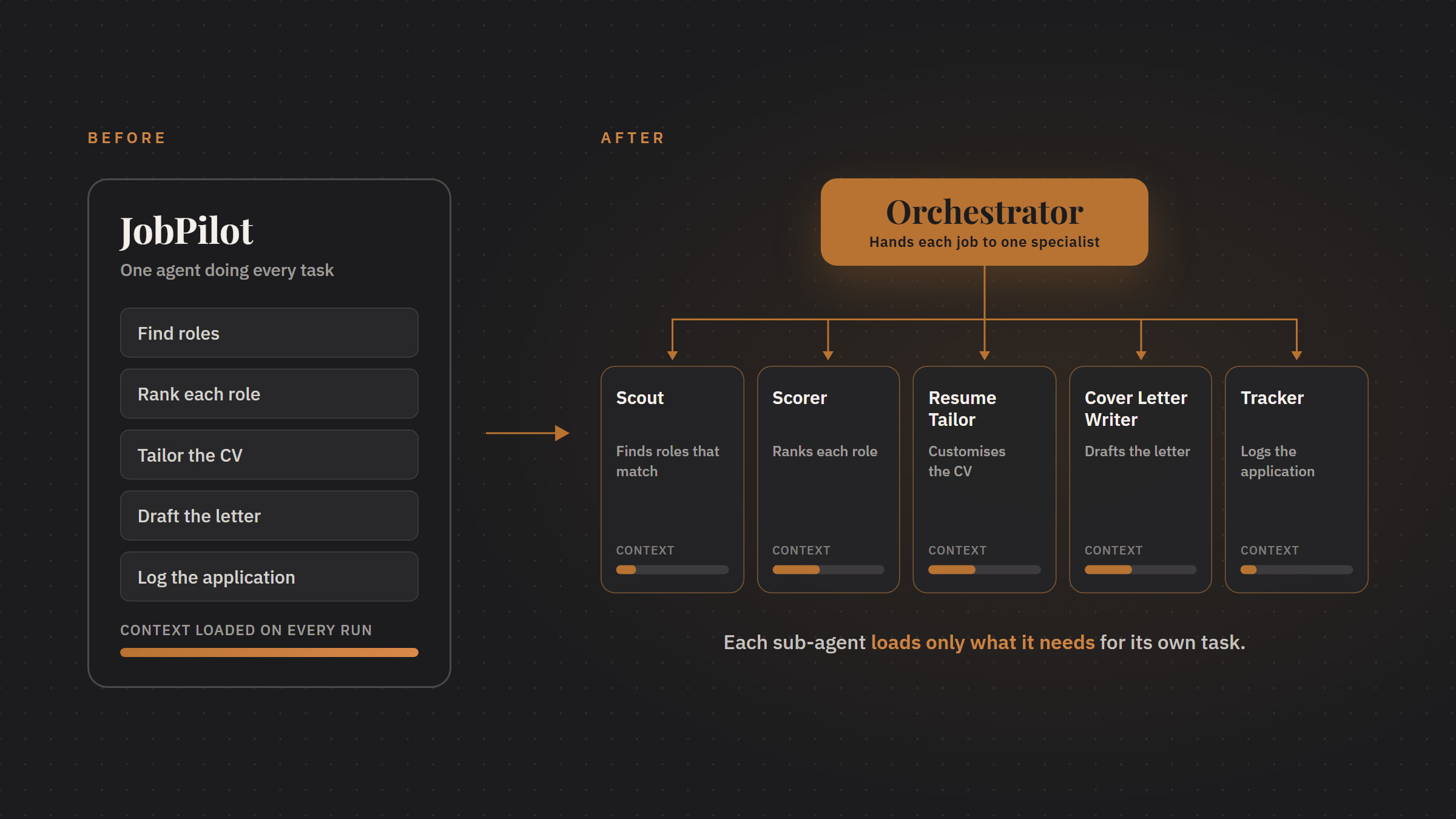
The first version of JobPilot was one agent doing everything. It searched for roles matching my criteria, scored each listing against my background, tailored my resume to the specific role, drafted a cover letter, and logged the application with status and follow-up dates. Five distinct jobs, one agent working through all of them in sequence.
It worked. By the end of the bootcamp, most of the room had a working agent of their own, not a prototype, something they could actually use. Mine went straight into my job search the following week.
Where the day actually went
Most of the bootcamp was not spent thinking about the tool. It was spent thinking about the process. Before I opened Claude Cowork, I had to sit down and map out my own job search step by step, including the steps I had never written down because they only existed in my head. Which parts of a resume I reach for first when a listing mentions “stakeholder management.” What a good cover letter opening sounds like versus one that reads like a template. When a follow-up is worth sending and when it just looks desperate.
That mapping exercise took longer than building the agent itself. Once the workflow was clear, translating it into something Claude Cowork could execute was fast. The bottleneck was never the technology. It was getting my own process out of my head and onto the page clearly enough that a system could follow it.
The problem I only found by using it
The single-agent version is what I presented at the AI Native Circle Showcase at Singapore Management University in April. It worked well enough to demo. It was only after the showcase, using JobPilot for real applications week after week, that I noticed the strain.
Every time I asked it to do something as small as logging a new application, it was pulling in the full job description, my entire resume, and the reasoning behind every prior scoring decision, because all five tasks lived inside one agent with one shared context. Logging an application does not need any of that. Neither does drafting a follow-up. The agent was re-reading everything on every run, whether the task in front of it needed that context or not.
So I rebuilt it. JobPilot is now five sub-agents, each doing one job. A search agent finds listings against my criteria. A scoring agent ranks them against my background. A resume agent tailors the CV for a specific role. A cover letter agent drafts the letter. A logging agent tracks applications and follow-ups. Each one loads only what it needs to do its own task, instead of carrying the weight of the whole pipeline every time. You can watch the five sub-agents hand off the work on the JobPilot project page.
What surprised me
I expected the hard part of building JobPilot to be technical. It was not. The hard part, both the first time and the second time round, was being honest about my own process, including the bits that were inefficient or that I did out of habit rather than reason. Splitting one agent into five was not a coding exercise either. It was asking, again, which parts of this workflow are actually separate decisions that do not need to see each other’s homework.
That is not a technical skill. It is the kind of clarity that comes from running a process often enough, and watching closely enough, to notice where it is straining.
Seeing it land
Watching people at the SMU showcase recognise their own workflows in what I had built, a hiring process, a client onboarding sequence, a supplier follow-up routine, was the moment JobPilot stopped being about my job search and started being about something bigger. The refinement since has only confirmed it. The same approach, breaking one overloaded process into focused parts, works for almost any workflow someone has run often enough to know cold.
If you are sitting on a workflow like that, one you could walk someone through blindfolded, that is the starting point. Not the tool. The process you already carry in your head, and the willingness to keep questioning how it is built even after it works.

Written by Damien Goh
I help manufacturers and F&B businesses turn their operational knowledge into practical AI agents and clearer digital transformation decisions. Based in Singapore.
Related reading
Want to talk about this?
Whether it sparked a question or you want to explore how it applies to your work, I am happy to chat.
Get in touch